“Every student can learn just not on the same day, or the same way” (George Evans). This quote to me sums everyone’s entitlement to education even though everyone’s learning capacity is different. So why in school is there this prejudice to children who don’t get the answer straight away or whom don’t follow the standard teaching procedures? A phenomena especially seen in children with severe learning difficulties.
It has been widely reported the government is cutting down funding for each pupil, leaving teachers under pressure, but these policies are particularly harmful for children with special needs [1]. This could be a reason why schools, whether private, state or special needs are less willing to put in the effort to help those individuals, but there is more to it. Inequality as a society is a major factor for why there is a lack of assistance whilst status in league tables is a driving force in decreasing motivation to aid or even enrol our vulnerable.
It could be questioned why isn’t there GCSE, A level or degree equivalents (possibly in the form of vocational training) as special needs kids deserve qualifications too, they also need to apply for jobs. They have rights like every other child.
There is about an estimated 1.7 million or more school children who have a disability be it either physical or emotional [2], yet despite this number there is not adequate support. Children with learning difficulties are most likely to leave school without a proper education, employment and training [3]. It would seem schools are less willing to put in the time and effort to create specific plans for special needs students.
Added to this, certain behaviours that come with severe learning disabilities such as Autism are often seen as distracting, done on purpose and troubling for other students [4]. What this suggests is that a child with learning difficulties is at fault and he/she should be like the “ideal that child” who gets stunning grades and doesn’t need help. This skews reality, driven by a wider societal view of people with disabilities as ‘lesser’, so much for the adverts saying teachers are here to inspire, and enabling the best outcome possible regardless of what situation you come from. What people fail to realise is that some kids with disabilities can’t talk and gestures like clapping hands or pacing up and down is a form of communication of how they are feeling, and putting the correct provision in place can help integrate this.
These educational failings leave parents and siblings of a child with learning difficulties frustrated and angry at the ignorance of the school system. Some of these children have no choice but to be home schooled by family members due to procedures not put in place, further pushing them out of society and robbing them of there formative years of learning to socialise [5]. Plus what happens if all family members have to work to bring in an income? This is unfair and is the antithesis of “ Education for all”.
In the end many have no choice to put into a special needs school without input. Whilst sometimes these schools can be ideal, there are many issues and they often aren’t of a high standard (but there’s a topic for another day).
There is so much scope for improving education for those with learning difficulties, but to do so we must change as a society. We must prioritise funding and we must learn to include, yet also we must measure success not on league tables instead let’s do this on exceeding everyone’s potential.
1
2
https://www.theguardian.com/education/2010/sep/14/ofsted-special-needs-report-criticised
3
4
https://www.bbc.co.uk/news/education-49640713
5
https://www.bbc.co.uk/news/education-46400397
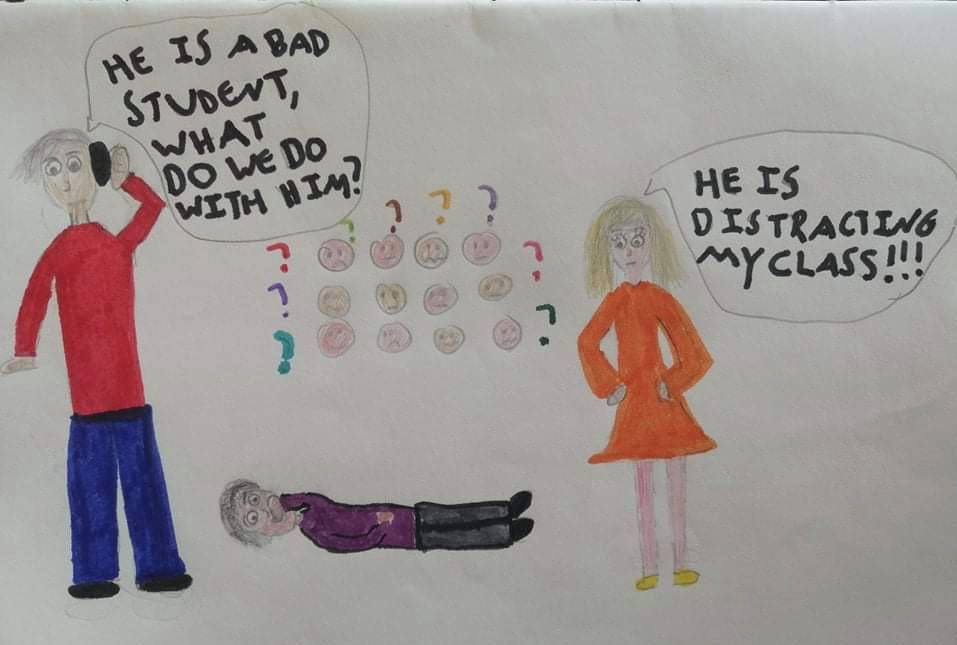
Fig. shows 2 teachers discussing their Autistic students behavior in a negative manner with students confused.
 Jacob's Time