Intensive interaction is a practical approach that can help children and adults who are in the early stages of communication development. Thought up by Dr David Hewett and his team after observing a class in a special needs school. It was developed through literature and research and has shown positive results.
The technique can be used to support people who have complex disabilities such as those who are congenitally deaf blind, have autism, learning disabilities or have Dementia. It helps allows them to relate, as well as share experiences with others on their own terms.
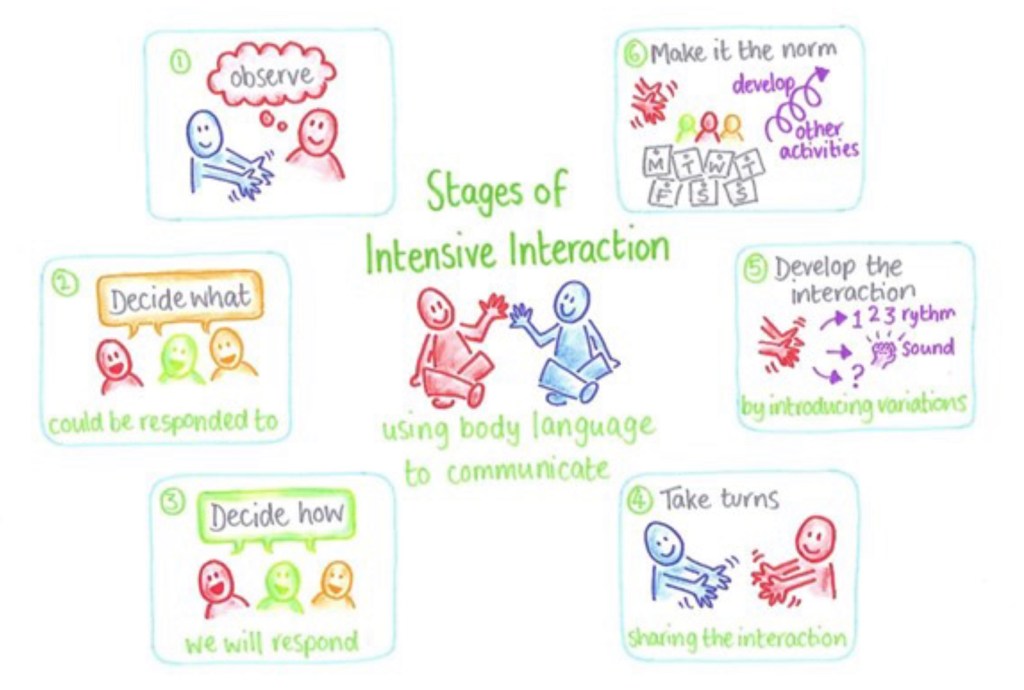
It achieves this through Teaching and developing the “fundamentals of communication”- this consist of understanding eye contact, facial expressions, vocalisations which in turn can lead to speech, taking turns when conversing and participating in the structure of a conversation [1][2]. Nind and Hewett (1994) sum it up as employing the ‘fundamentals of communication’ to build social interactivity [3]. This is shown in Fig 1.
My own families experiences with intensive interaction have been positive. With Jacob it took a while, he was non verbal which was a bit harder, of course what you have to realize is it takes time and doesn’t happen straight away. At the time I was skeptical, I was stressed and in fact was doing it wrong. The key is to relax into it and enjoy sharing this activity with the person with whom you are interacting. One mistake I made was that I was trying to be a mum when Jacob wanted a sister. Sisters are for having fun, doing activities that you wouldn’t do with parents, he already had a mum he didn’t want another. Once I understood this, I would copy him listening to music, then it built up to both having enjoyment with a hair dryer. We were very close, he would hold my hand when we would finish coming down the waterslide and after swimming he would sit on my lap. In fact one funny moment was we when used to share the same bed, I woke up and found his arm wrapped around me, I was shocked and in a panic as he hadn’t done this before, I look at it now and it was really sweet. Intensive interaction helped me to build this relationship, as well as aided my to reestablish it when returning from my times at university.
In my opinion we should encourage everyone to learn it especially teachers and school staff as well as aiming to get it recognized by the government.
[1]https://www.intensiveinteraction.org
[2]http://www.autismtrainingcenter.net/?page_id=3923
[3] https://thepsychologist.bps.org.uk/volume-22/edition-9/introducing-intensive-interaction
[4] https://www.sense.org.uk/get-support/information-and-advice/communication/intensive-interaction/
 Jacob's Time