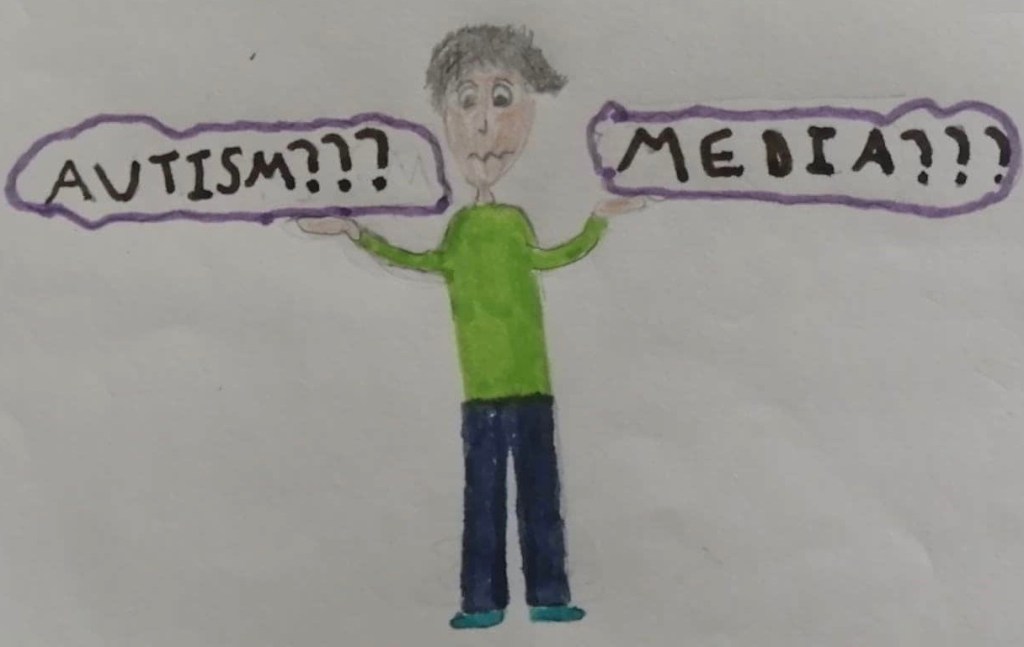
Over the next few weeks I’m going to highlight various stereotypes of Autism in the media . I will post a blog each week discussing a few examples of various stereotypes used in film and media. In the last blog I will summaries my own thoughts on the issue. I hope it can be of interest and spark discussion as to what representation is appropriate and why we don’t have more/ better examples, whilst also giving feel some films to look up and form your own opinion.
A stereotype is a fixed general image or set of characteristics that a lot of people believe represent a particular type of person or thing [1]. Stereotypes are important as they affect the way we interact with people [2] as well as possibly even leading to more negative outcomes for those with which negative stereotypes are associated [3].
Often the Autism that it is portrayed shows only one side of the story, and is either one or the other of two extremes. One extreme shown is bleak and seen as the end of the world, for the person as well as the family. The other is that the person is a genius and will live an exceptional life. Although these can be seen in some Autistic people, it is not representative of the whole Autistic spectrum (Firth & Happe, 2005).
Over the course of a series of blogs, I will present examples of media depictions of autism. It will firstly look into some examples where the media uses autism in an inspirational manner. Then adolescent Autism portrayal followed by some negative depictions of autism will be examined, with finally some more positive media representations of the condition.
1 https://www.collinsdictionary.com/dictionary/english
2 https://pubmed.ncbi.nlm.nih.gov/7878162/
3 https://www.sciencedirect.com/science/article/pii/S0065260102800090
4 https://www.cell.com/current-biology/fulltext/S0960-9822(05)01103-6
 Jacob's Time