
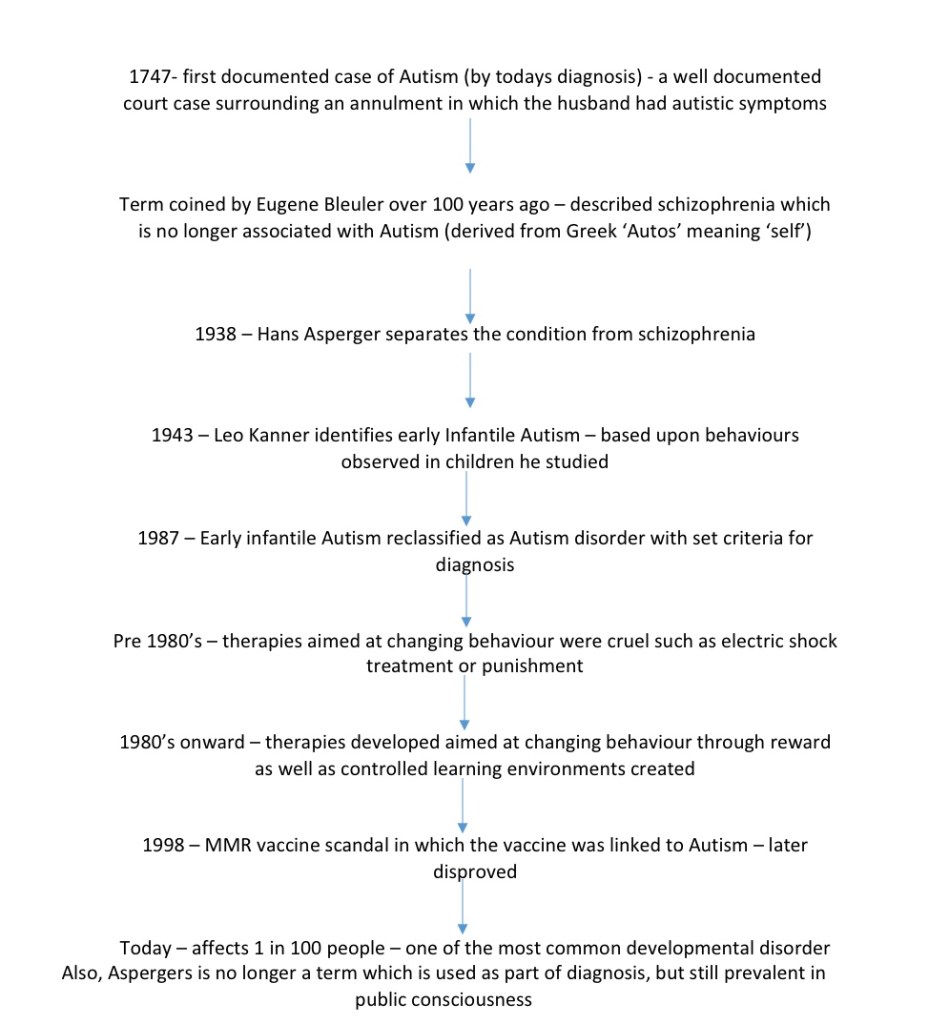
Autism is a developmental disability that lasts for life, and alters how a person communicates relates to people, it affects the individuals experience of the world around them. There are many different levels of Autism for which various support is needed, and is therefore a spectrum condition[1]. Autism as a term has been in use for just over 100 years [2], with the history of the condition being shown if the figure 1 below.
There are around 100 known genes that increase the risk of Autism, with some able to cause the condition on their own [10]. For example, there is a strong association between denova copy number mutations and autism. Also, studies show there are mutations in single genes whilst affected genomic regions are extremely heterogeneous (diverse in character or content) [11]
Furthermore, [12] it has been shown how in mice neuroligin 3 mutation causes impaired social interactions but improved spatial learning. Furthermore, there was an alteration in the inhibitory/excitatory balance that alter oscillatory rhythms in brain. Autism has also been explored through neurophysiology (concerned with the study of the functioning of the nervous system) enhancing the understanding of brain-impairment in multiple regions [13]. It has been concluded that most autistic people have impairments of the frontal lobe leading to variability in language and memory abilities. Moreover, [14] there is evidence that environmental factors also contribute. These could be due to many factors including maternal and paternal reproductive history, diet, illnesses, and medications during pregnancy, pesticide use, and the child’s early life exposures.
1 https://www.autism.org.uk/advice-and-guidance/what-is-autism
2 https://journals.sagepub.com/doi/full/10.1177/0952695113484320
3 https://search.proquest.com/docview/1883578864?pq-origsite=gscholar&fromopenview=true
4 https://journals.sagepub.com/doi/full/10.1177/0952695113484320
5 https://pdfs.semanticscholar.org/ce87/8c9cee3d1ba5113111f8cdd0ff2db15a6805.pdf
6 https://link.springer.com/article/10.1007/BF01537624
7 https://harkla.co/blogs/special-needs/history-of-autism
9https://acamh.onlinelibrary.wiley.com/doi/abs/10.1046/j.0021-9630.2003.00317.x
10 https://pubmed.ncbi.nlm.nih.gov/19360646/
11https://pubmed.ncbi.nlm.nih.gov/17363630/
12 https://science.sciencemag.org/content/318/5847/71.full
 Jacob's Time