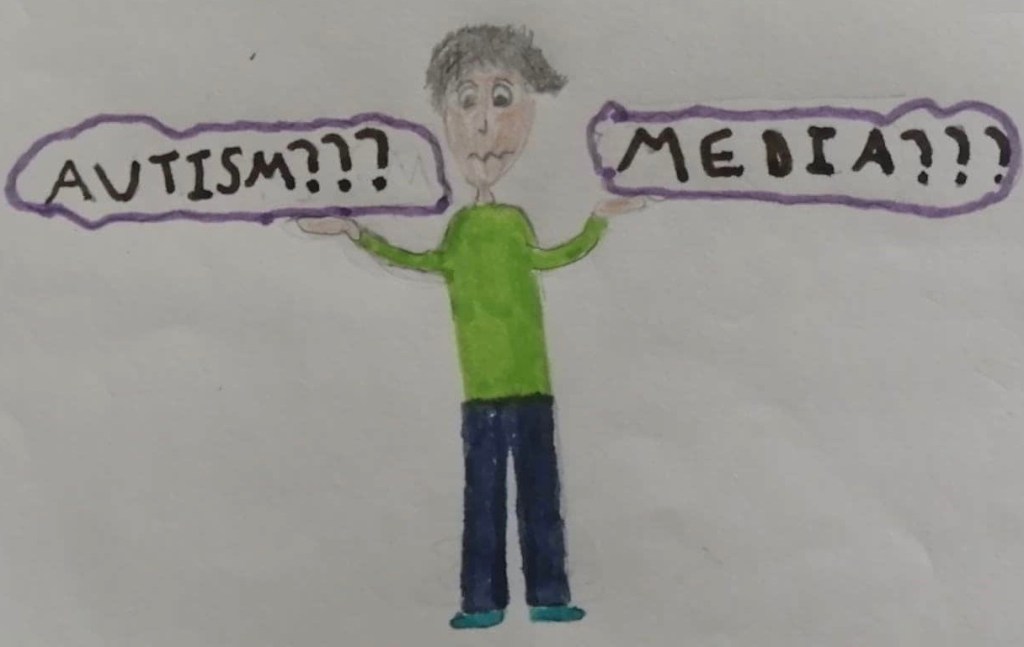
Over the next few weeks I’m going to highlight various stereotypes of Autism in the media . I will post a blog each week discussing a few examples of various stereotypes used in film and media. In the last blog I will summaries my own thoughts on the issue. I hope it can be of interest and spark discussion as to what representation is appropriate and why we don’t have more/ better examples, whilst also giving feel some films to look up and form your own opinion.
A stereotype is a fixed generalimage or set of characteristics that a lot of people believerepresent a particular type of person or thing [1]. Stereotypes are important as they affect the way we interact with people [2] as well as possibly even leading to more negative outcomes for those with which negative stereotypes are associated [3].
Often the Autism that it is portrayed shows only one side of the story, and is either one or the other of two extremes. One extreme shown is bleak and seen as the end of the world, for the person as well as the family. The other is that the person is a genius and will live an exceptional life. Although these can be seen in some Autistic people, it is not representative of the whole Autistic spectrum (Firth & Happe, 2005).
Over the course of a series of blogs, I will present examples of media depictions of autism. It will firstly look into some examples where the media uses autism in an inspirational manner. Then adolescent Autism portrayal followed by some negative depictions of autism will be examined, with finally some more positive media representations of the condition.
Intensive interaction is a practical approach that can help children and adults who are in the early stages of communication development. Thought up by Dr David Hewett and his team after observing a class in a special needs school. It was developed through literature and research and has shown positive results.
The technique can be used to support people who have complex disabilities such as those who are congenitally deaf blind, have autism, learning disabilities or have Dementia. It helps allows them to relate, as well as share experiences with others on their own terms.
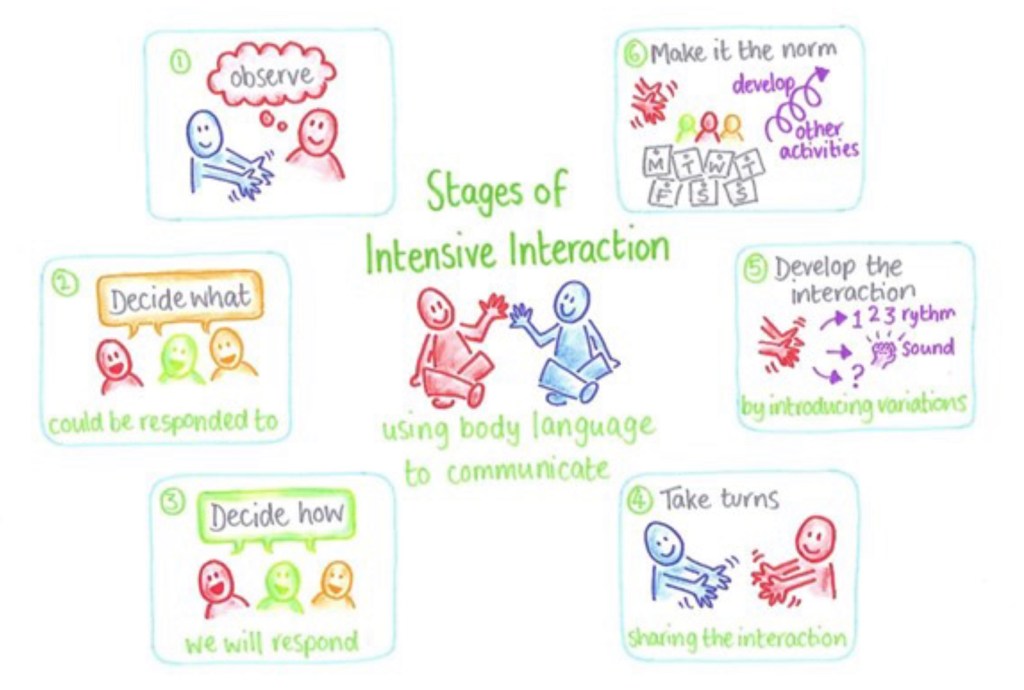
It achieves this through Teaching and developing the “fundamentals of communication”- this consist of understanding eye contact, facial expressions, vocalisations which in turn can lead to speech, taking turns when conversing and participating in the structure of a conversation [1][2]. Nind and Hewett (1994) sum it up as employing the ‘fundamentals of communication’ to build social interactivity [3]. This is shown in Fig 1.
Fig 1 explaining the steps of intensive interaction. This sort of media should be encouraged when displaying Autism as it is a spectrum, and these therapies which can help. Intensive interaction promotes alternative communication techniques. It is important the person with autism takes the lead, so first they must be observed. Once behaviours that need responding to are identified, a response is decided. It is vital to take turns responding with the autistic person to develop your communication. Finally, this must be regularly repeated so it becomes the norm [4].
My own families experiences with intensive interaction have been positive. With Jacob it took a while, he was non verbal which was a bit harder, of course what you have to realize is it takes time and doesn’t happen straight away. At the time I was skeptical, I was stressed and in fact was doing it wrong. The key is to relax into it and enjoy sharing this activity with the person with whom you are interacting. One mistake I made was that I was trying to be a mum when Jacob wanted a sister. Sisters are for having fun, doing activities that you wouldn’t do with parents, he already had a mum he didn’t want another. Once I understood this, I would copy him listening to music, then it built up to both having enjoyment with a hair dryer. We were very close, he would hold my hand when we would finish coming down the waterslide and after swimming he would sit on my lap. In fact one funny moment was we when used to share the same bed, I woke up and found his arm wrapped around me, I was shocked and in a panic as he hadn’t done this before, I look at it now and it was really sweet. Intensive interaction helped me to build this relationship, as well as aided my to reestablish it when returning from my times at university.
In my opinion we should encourage everyone to learn it especially teachers and school staff as well as aiming to get it recognized by the government.
I wanted to do a positive article to help your child with learning difficulties.
We should keep Autistic people or anyone with learning difficulties busy as it is vital. It is good
For mental health, educates them, builds social skills, burns energy, allows better sleep, aids with pain and much more. On top of this sensory experiences are important as they stimulate the senses such as “touch, smell, sight, taste, and sound, as well as the two not-as-frequently-mentioned senses: vestibular (sense of balance) and proprioceptive (sense of where each body part is in relation to the rest)”[1][2]. In turn this ensures your child with learning difficulties will be calm and healthy.
When doing activities you can get 1:1 sessions or Autism/learning difficulties specific events. On top of this often team sports can be useful for high functioning Autism whilst one to one is often suited to low functioning, but it depends on your child, you know them best. The point is to keep them stimulated and busy as well as to give them opportunities like everyone else does[3].
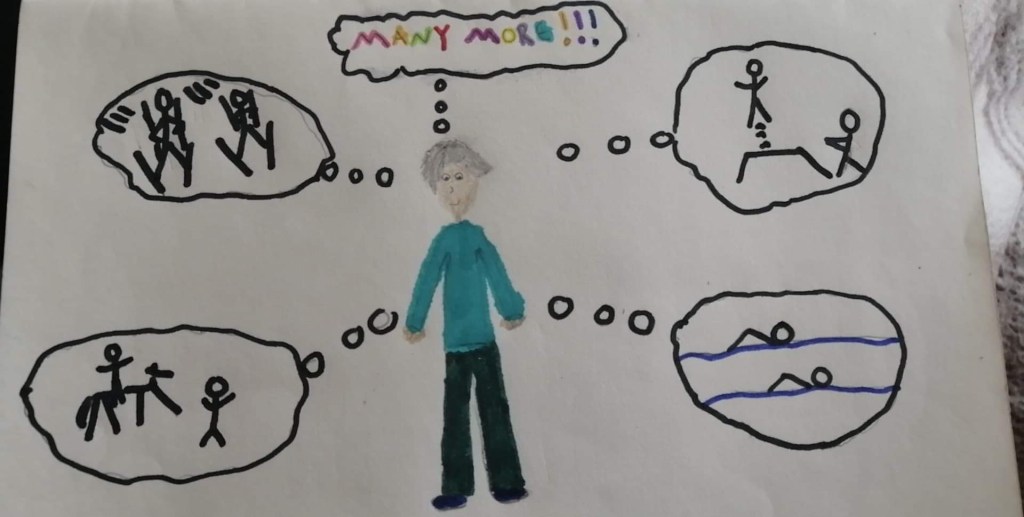
Jacob does swimming where he has 1 to 1 time with a swim teacher who is willing to push him, He needs this, as even though I love him to bits, he can be lazy sometimes. Moreover, he does horse riding, it helps him with his balance and gets him used to animals. Furthermore, we do activities as a family such trampolining , ice skating, roller blading, climbing , going to water slides etc. This builds character and encourages kids with learning difficulties to be confident. I find that when Jacob has had a productive day, his personality comes out, he can be cheeky, loving and full of charisma. What is also important is the fact a parent or sibling can bond with their child with learning difficulties, (possibly through Intensive interaction , which I’ll save for another day) when they do their activities. One day when he is old enough I want to take him to a club because of his love for music and dance.
This is a starter list of activities you could do with your person with SpLD: Underneath I have put links to certain activities that might help you explore.
Horse riding RDA
Slides (water and park)
Swimming (ask your local leisure centre if can get 1 on 1 and if they have own section of swimming pool as well as having someone one who pushes your child)
Getting them to play any instrument
Dj-ing
Trampolining
Go karting
Reading books (ones make sounds and loads of pictures, their favourite book)
Cooking/baking
Climbing
Skiing/snowboarding, tobogganing
Cinema
Bowling
Dancing and singing together with your kid with learning difficulties (their auditory works like everyone else’s and compensates for cognitive progresses).
Concerts
Musicals/opera/Ballet
Ice skating
Surfing
Transport journeys
Roller-skating
Animal therapy
Yoga
Massages (Tui na or any massages)
Ice skating
(You can inquire if places do special autism/ Learning difficulties times for activities, anything can be made into an activity eg Daily normalities: Jacob likes ironing or using the hoover, the hair dryer and getting a hair cut, even if it is for a short period it is still good for them).
Also, there are schemes that encourage people with learning difficulties to go out. Jacob can get activities paid for him provided receipts are shown that he did them. I would personally look into this if you have a child/ grown up like my brother.
A few links to activities:
Go Karting
Here is a link to an article talking about promoting go karting to children with Autism as well as a link to the Karting Centre discussed in the article. Other places may be suitable, a bit of searching might be needed or contact your local karting centre.
Here is a link to certain musicals that can be watched. You can go to Autism friendly performances or look into going to one that everyone goes to. I find sitting at the back is good so if your child with learning difficulties needs a break you can quickly take them out.
Here is a link to the Cinemas that are Autism friendly or you could wait for a screening of a particular film to not be busy and take your person with learning difficulties to it.
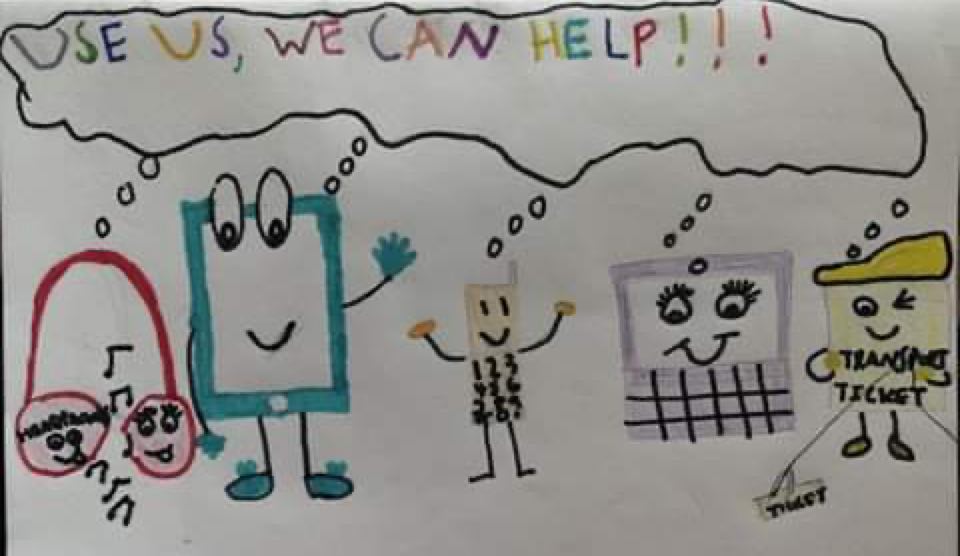
Fig 1 shows cartoons of technologies and transport tickets saying ‘use us, we can help’
There is a dichotomy facing people with learning difficulties in terms of expectations. On one hand, you have the optimistic believers, often family members, who expect a miracle and believe the person will somehow be cured, sometimes without even putting effort in. On the other hand, you have those who believe the child with Autism or SPLD (Specific learning difficulties) are doomed and will never achieve anything. In reality, most children will exist somewhere in the middle, so it is important to examine what the person enjoys and possibly excels at and encourage these activities, whilst not neglecting other essential skills. This is no different to how people view their nondisabled child, it just might be a little more difficult, yet can be extremely rewarding.
Currently there are little to no mechanisms to enable these children into jobs or educational practices, such as utilising the things child with learning difficulties enjoys. For example, my brother Jacob loves his Nintendo, IPAD and mobile phone, he is often found listening to music and loves transport such as trains, cars or planes. These sort of activities are often attractive to people with learning difficulties such as Autism and can give them great benefit [1]. Could not these enjoyments be identified and used to give them an outlet and earn money? In my brother’s case there could gadget testing jobs or assessing transport from a customer standpoint. In a world where very little is designed for special needs people their opinions are even more valuable. Even though someone can’t talk they have ways of communicating through actions such a body language, after all who better to give advice to make transport more disability friendly, then those who require those services.
A lot of special need children develop mental health issues [2] in part as they have nothing to do when they finish school. They need to learn to be independent which technically is what the government promotes but in reality doesn’t do much about. As a sister to someone with severe Autism and ADHD I really want him to live a fulfilling life and have the opportunities that any other child would have, even if it comes in a different form.
Schools and the government need to step up to the plate. I believe any subject whether English, math, science or French can be better tailored and be made applicable to anyone, it’s just needs to be put in the right format that anyone with severe difficulties can understand. This would be a good start to delivering an equal society for those with learning difficulties (or any disability for that matter).
To cap it off, often when looking for employees, firms do not want to take on someone with severe learning disabilities as it is seen to be a lot of effort and costly, despite the 2010 disability equality act [3] being passed, as well as schemes such as Access to Work [4]. This is similar to the education dilemma where effort is not put in and stigma prevails. In reality, if people with learning difficulties are given the right support within the job they have, they bring qualities such as new perspectives, better understanding of certain situations, new ideas, determination, passion and good moral for the team [5]. It has even been shown that a more diverse work force increases productivity [6].
“Every student can learn just not on the same day, or the same way” (George Evans). This quote to me sums everyone’s entitlement to education even though everyone’s learning capacity is different. So why in school is there this prejudice to children who don’t get the answer straight away or whom don’t follow the standard teaching procedures? A phenomena especially seen in children with severe learning difficulties.
It has been widely reported the government is cutting down funding for each pupil, leaving teachers under pressure, but these policies are particularly harmful for children with special needs [1]. This could be a reason why schools, whether private, state or special needs are less willing to put in the effort to help those individuals, but there is more to it. Inequality as a society is a major factor for why there is a lack of assistance whilst status in league tables is a driving force in decreasing motivation to aid or even enrol our vulnerable.
It could be questioned why isn’t there GCSE, A level or degree equivalents (possibly in the form of vocational training) as special needs kids deserve qualifications too, they also need to apply for jobs. They have rights like every other child.
There is about an estimated 1.7 million or more school children who have a disability be it either physical or emotional [2], yet despite this number there is not adequate support. Children with learning difficulties are most likely to leave school without a proper education, employment and training [3]. It would seem schools are less willing to put in the time and effort to create specific plans for special needs students.
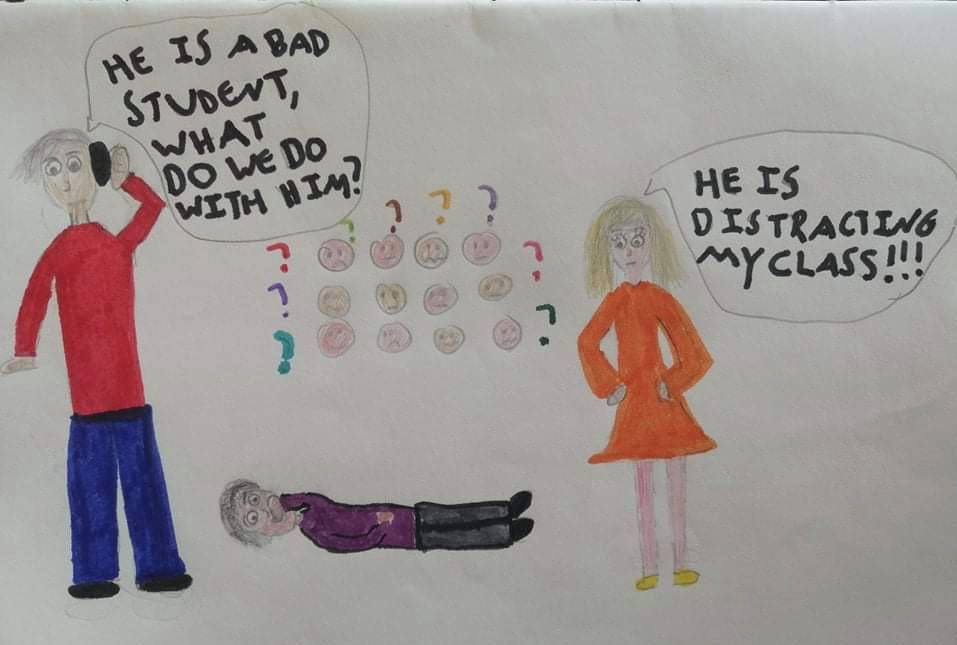
Added to this, certain behaviours that come with severe learning disabilities such as Autism are often seen as distracting, done on purpose and troubling for other students [4]. What this suggests is that a child with learning difficulties is at fault and he/she should be like the “ideal that child” who gets stunning grades and doesn’t need help. This skews reality, driven by a wider societal view of people with disabilities as ‘lesser’, so much for the adverts saying teachers are here to inspire, and enabling the best outcome possible regardless of what situation you come from. What people fail to realise is that some kids with disabilities can’t talk and gestures like clapping hands or pacing up and down is a form of communication of how they are feeling, and putting the correct provision in place can help integrate this.
These educational failings leave parents and siblings of a child with learning difficulties frustrated and angry at the ignorance of the school system. Some of these children have no choice but to be home schooled by family members due to procedures not put in place, further pushing them out of society and robbing them of there formative years of learning to socialise [5]. Plus what happens if all family members have to work to bring in an income? This is unfair and is the antithesis of “ Education for all”.
In the end many have no choice to put into a special needs school without input. Whilst sometimes these schools can be ideal, there are many issues and they often aren’t of a high standard (but there’s a topic for another day).
There is so much scope for improving education for those with learning difficulties, but to do so we must change as a society. We must prioritise funding and we must learn to include, yet also we must measure success not on league tables instead let’s do this on exceeding everyone’s potential.
 Jacob's Time